Home » Commercial Scaffolding Services
A commercial scaffold is not a bigger domestic one. It is a working platform that has to carry a stated load, stay up for a stated period, survive an unannounced HSE visit, and come off to a programme that other trades are planned around. Those four things decide what it costs, and they are what we quote against.
We are an Oxfordshire contractor working from a yard at Enslow, near Kidlington, on commercial work across Oxfordshire, Buckinghamshire, Northamptonshire, Bedfordshire and Gloucestershire. CISRS-qualified scaffolders, CHAS Advanced, £10 million public liability, and Oxfordshire Prestige Awards Scaffold Company of the Year since 2020.
Four things, and none of them are size.
Price per square metre tells you almost nothing until those four are settled. Two quotes for the same elevation can differ by half, and usually the cheaper one has assumed a lighter duty class and a shorter hire.
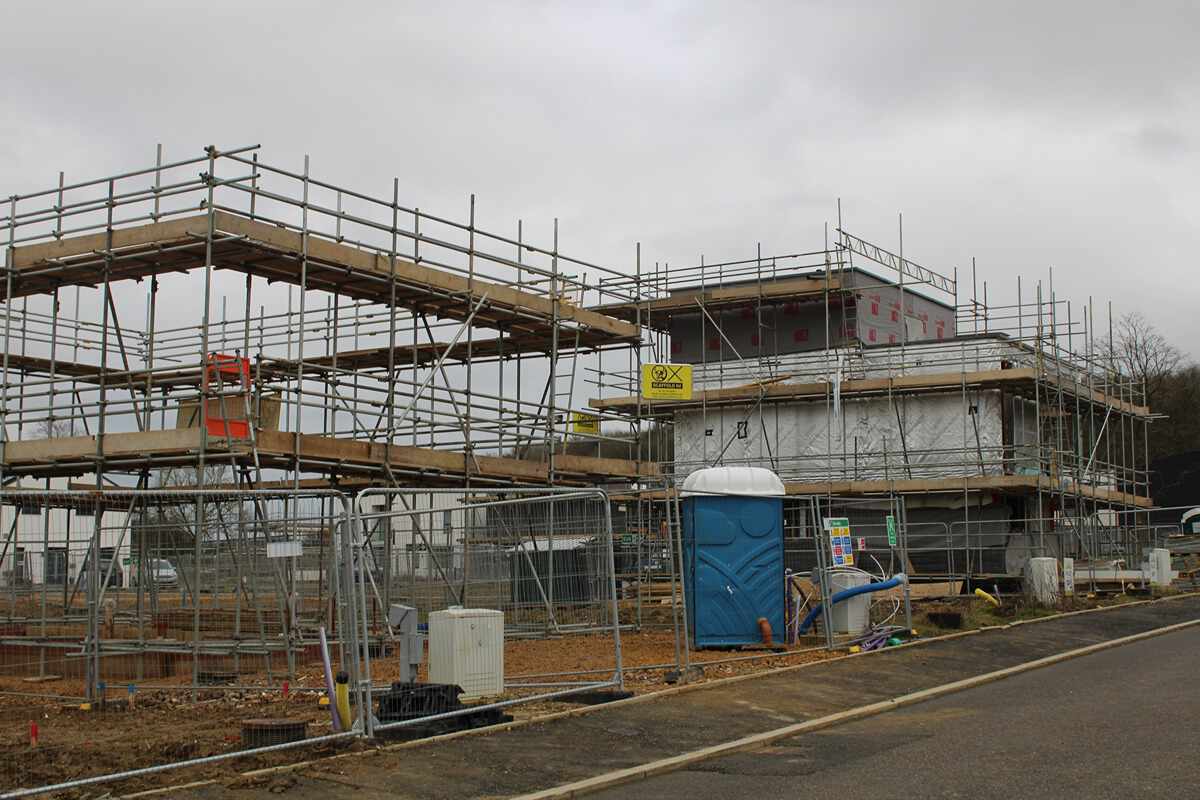
If three commercial quotations come back hundreds of pounds apart, the duty class is usually why. A scaffold is designed and handed over to a class under BS EN 12811-1, and that class is the load it is permitted to carry per square metre. A lighter class uses less material and less labour, so it quotes cheaper — and is the wrong scaffold if your programme loads it out.
| Class | Load | Typical use |
|---|---|---|
| Class 1 | 0.75 kN/m² | Inspection only — access, no materials |
| Class 2 | 1.5 kN/m² | Light duty — painting, rendering, cleaning |
| Class 3 | 2.0 kN/m² | General purpose — most trades, light storage |
| Class 4 | 3.0 kN/m² | Heavy duty — masonry, blockwork, stone |
| Class 5 | 4.5 kN/m² | Heavier material handling |
| Class 6 | 6.0 kN/m² | Very heavy construction loading |
Class 3 is roughly 200kg per square metre, Class 4 roughly 300kg. The class is agreed in advance, recorded on the handover certificate, and must not be exceeded. Retro-fitting capacity into a standing scaffold means altering it, which is dearer and slower than specifying it correctly at tender. Tell us what is going on the boards and we will design to it.
Most commercial scaffolding is on premises that keep trading. That shapes the job more than the building does.
Under the Work at Height Regulations 2005, a scaffold must be inspected by a competent person before first use, at intervals of no more than seven days thereafter, and after any event likely to have affected its stability. Each inspection must be recorded.
After handover that duty sits with the person using the scaffold — normally the principal contractor, not the scaffolding contractor. It needs to be written into the contract rather than assumed, because where nobody has been told to do it, nobody does, and it is the first thing asked for after an incident. We do the handover inspection and tag the scaffold, and we will carry out the weekly inspections under the hire where that is what you want.
We work to TG20:21 for tube and fitting and SG4 for preventing falls during erection and dismantling, with CISRS-qualified scaffolders. We are Advanced CHAS accredited, and RAMS and a job-specific toolbox talk come before anyone climbs.
Give us those six and the quotation will be accurate rather than caveated.
This region has a particular mix, and it shapes the scaffolds more than the size of the buildings does.
Three separate things need settling, and they run on different clocks.
Out-of-hours erection is worth raising early. On an occupied retail or office building it is frequently the only way to get a scaffold up without closing the entrance, and it changes the labour cost rather than the structure.
From the yard at Enslow we cover commercial work across:
For commercial work the travel is rarely the deciding factor — a job of any length absorbs it. If you are near the edge of that and the job is commercial, ring us anyway.
Related: industrial scaffolding, temporary roofs and events and media structures.
We will also tell you when you do not need what you have asked for. A lighter duty class or a shorter hire is a cheaper scaffold, and it is better business for us to say so than to have you find out from the next quote.

Send us the elevations or a site plan, what trade is working off the scaffold and what they are putting on it, roughly how long you need it, and whether any of it stands on the public highway. That is enough for a firm figure on most commercial jobs without a visit, and we will come and look at anything larger.
Call 01869 254017 or email info@oxscaffold.co.uk.
As long as the job needs. We quote a hire period based on the programme you give us, and if the job runs on we extend it — but we will tell you what that costs rather than surprising you with it. On a commercial frontage where the scaffold stands on the highway, remember the licence runs with the scaffold, and in Oxfordshire it is charged monthly, so an overrun has two costs rather than one.
Yes. Our quotation covers erecting it, the hire period, and dismantling and removing it at the end. Taking it down is not a separate charge and it should not be one anywhere — if a quotation does not make that clear, ask before you accept it. What can be chargeable is an additional visit you ask us for mid-programme, such as an alteration or an extra lift, and we would rather price that up front than argue about it later.
No — and this matters more than anything else on this page. A scaffold may only be erected, altered or dismantled by a competent, trained scaffolder. Ours are CISRS-qualified and work to SG4. Removing a tie, a brace, a guardrail or a board changes how the whole structure behaves, and it invalidates the handover certificate and the inspection record. If the scaffold is in the way, or the programme has changed and you need it altered, call us on 01869 254017 and we will come and do it. We are ten minutes from Oxford, so it is rarely a long wait.
It is priced on the duty class, the area of the elevations, how long you need it and whether any of it stands on the highway — not on a flat rate per square metre, because the same elevation at duty class 2 and duty class 4 is a different structure. Give us the elevations, the trade working off it and the hire period and we will give you a firm figure, usually without a site visit.
It depends on what goes on the platform, not on the building. Inspection and light access is class 1 or 2; general trades such as rendering and painting are class 3; bricklaying and blockwork with materials stored on the lift is class 4; and heavier masonry or stored materials run to class 5 or 6 under BS EN 12811-1. Tell us the trade and what they are storing and we will state the class on the quote. If a quote does not mention one, that is worth asking about.
Yes. Anything outside the TG20:21 compliance sheets — loading bays, cantilevers, pedestrian fans, bridged entrances, sheeted elevations, temporary roofs — gets a bespoke design with calculations, and it is in the price rather than an extra. The drawing and the calculations go into your handover pack.
Frequently, and on occupied retail and office buildings it is often the only workable answer. It changes the labour cost rather than the structure, and it needs raising at the quoting stage rather than the week before, because the council and the building manager may both have a view on it.
Please feel free to contact us anytime to discuss your requirements.
Please feel free to contact us anytime to discuss your requirements. Or use the form below and we will get back to you as soon as possible.
We provide access solutions tailored to your requirements and have experience delivering on projects of considerable scale. Incorporated in 2018, Ox Scaffold Ltd have shown credibility within the industry and this was recognized by the Oxfordshire Prestige Awards from 2020 to present, winning ‘Oxfordshire’s Scaffold Company of the Year’.
Copyright © OX Scaffold Ltd | All Rights Reserved.