
Scaffolding in Aylesbury
Aylesbury is the county town of Buckinghamshire and one of the main towns we work in outside Oxfordshire — about forty minutes from our yard at Enslow along the A41. It is also growing fast: a Garden Town with thousands of new homes on its edges, a medieval old town at its centre, and the thatch, witchert and timber frame of the Vale villages all around it. This page is the work we have done in and around Aylesbury, and what each part of the town asks of a scaffold.
Projects in and around Aylesbury
A selection from our own job record in the town and the Vale villages around it. Every photograph is ours, taken on the job.
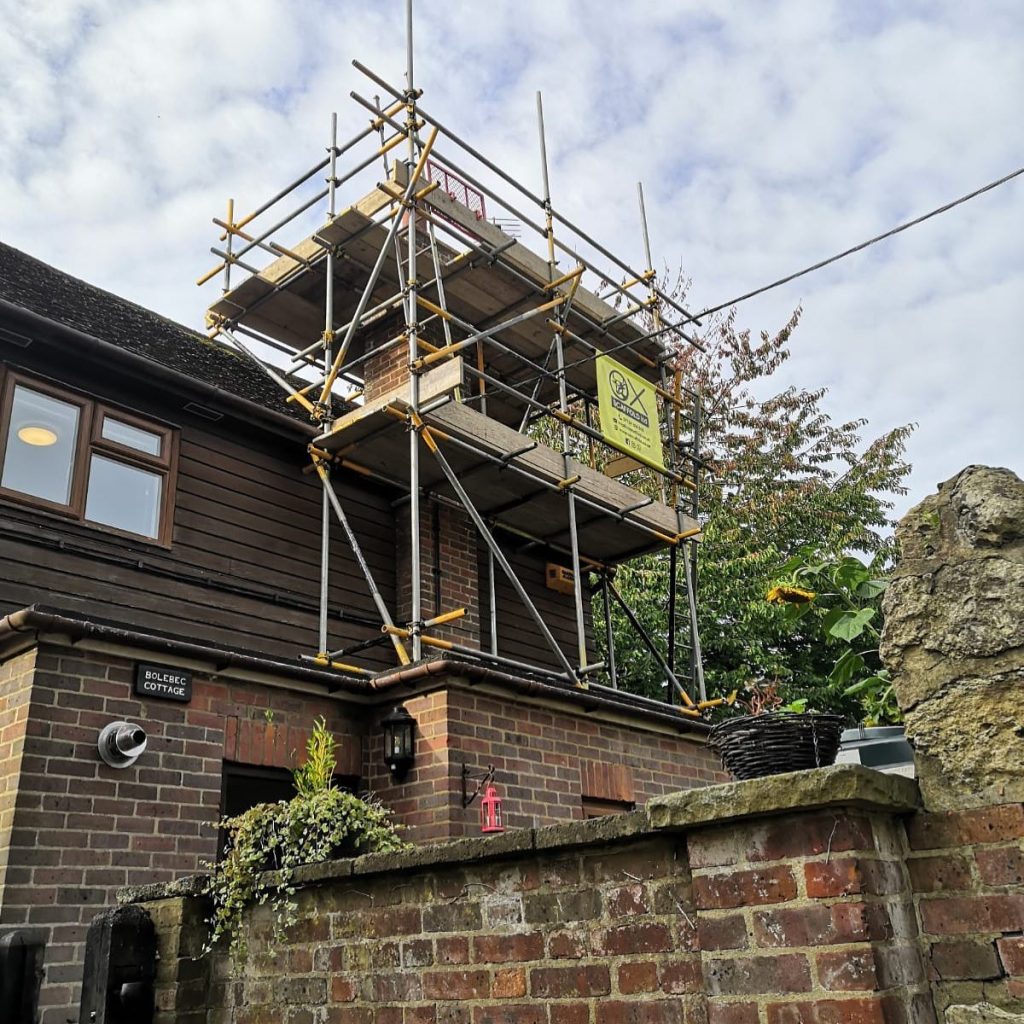
Chimney repairs, Aylesbury
Access for chimney repairs on a house in the town: a scaffold up the elevation with a platform round the stack and edge protection at the eaves, so the repair was done properly rather than from a ladder.
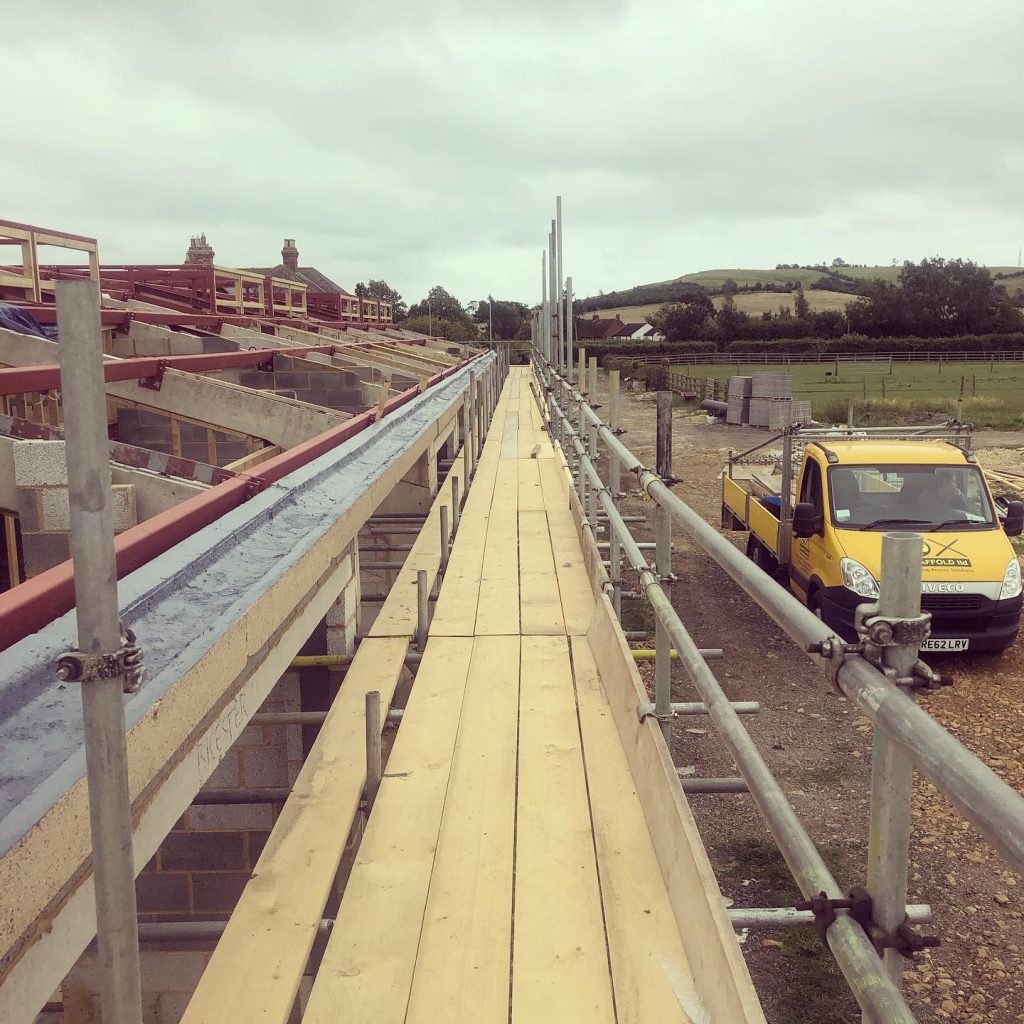
Roof and gutter scaffold, Aylesbury
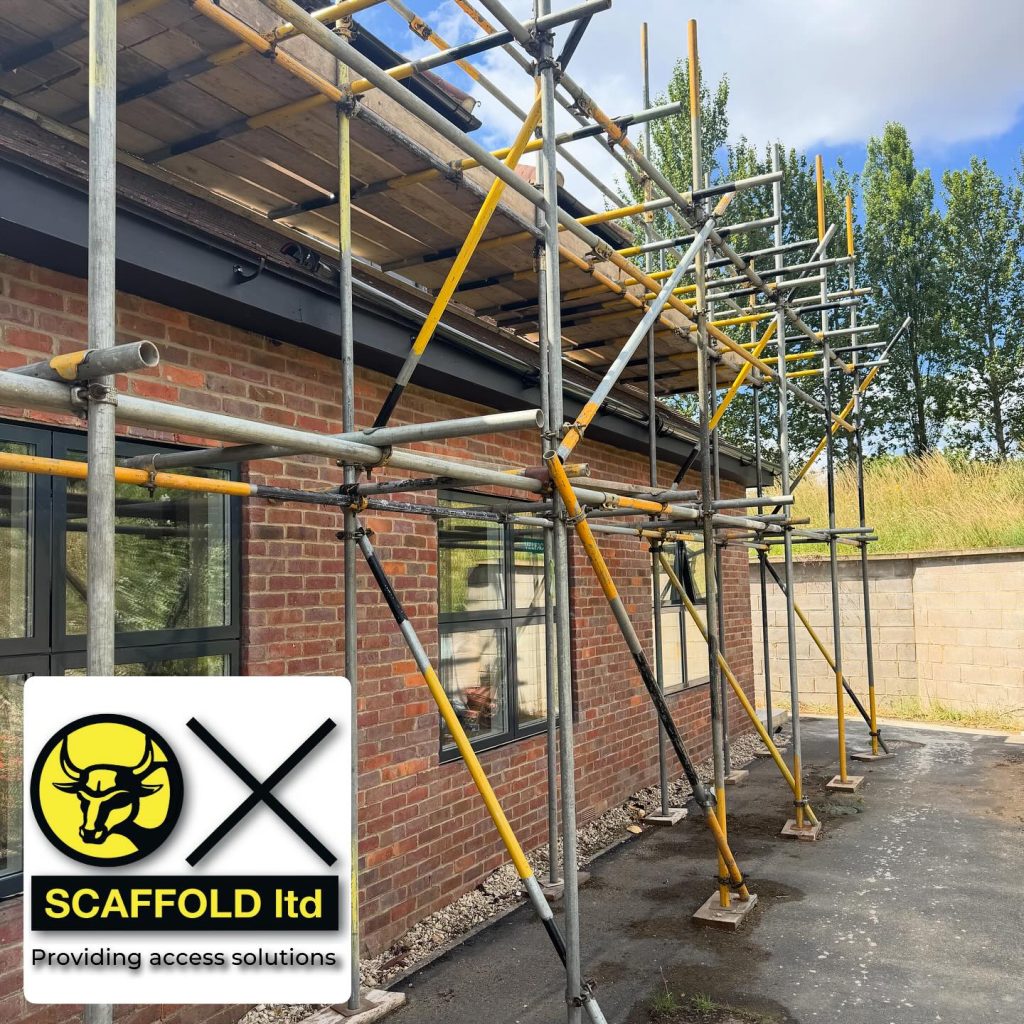
A boarded scaffold along the eaves for roof and gutter work, built with brand new boards delivered straight to site — a long, clean working platform for the roofers and the gutter fitters.
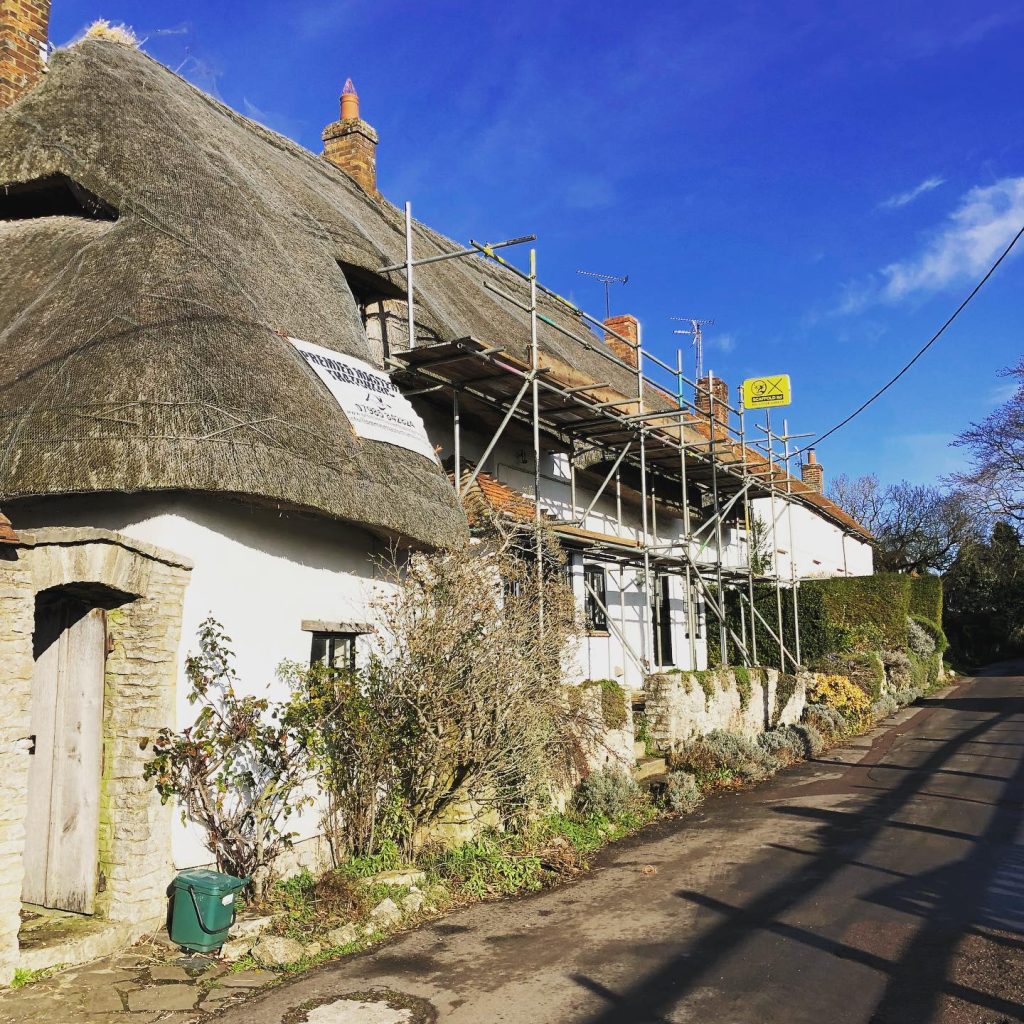
Thatch replacement, Dinton
A scaffold for the replacement of a thatched roof on a cottage in Dinton, five miles from Aylesbury. Thatch work needs a platform the full length of the roof at the right height for the thatchers, and care with the old walls the scaffold stands against.
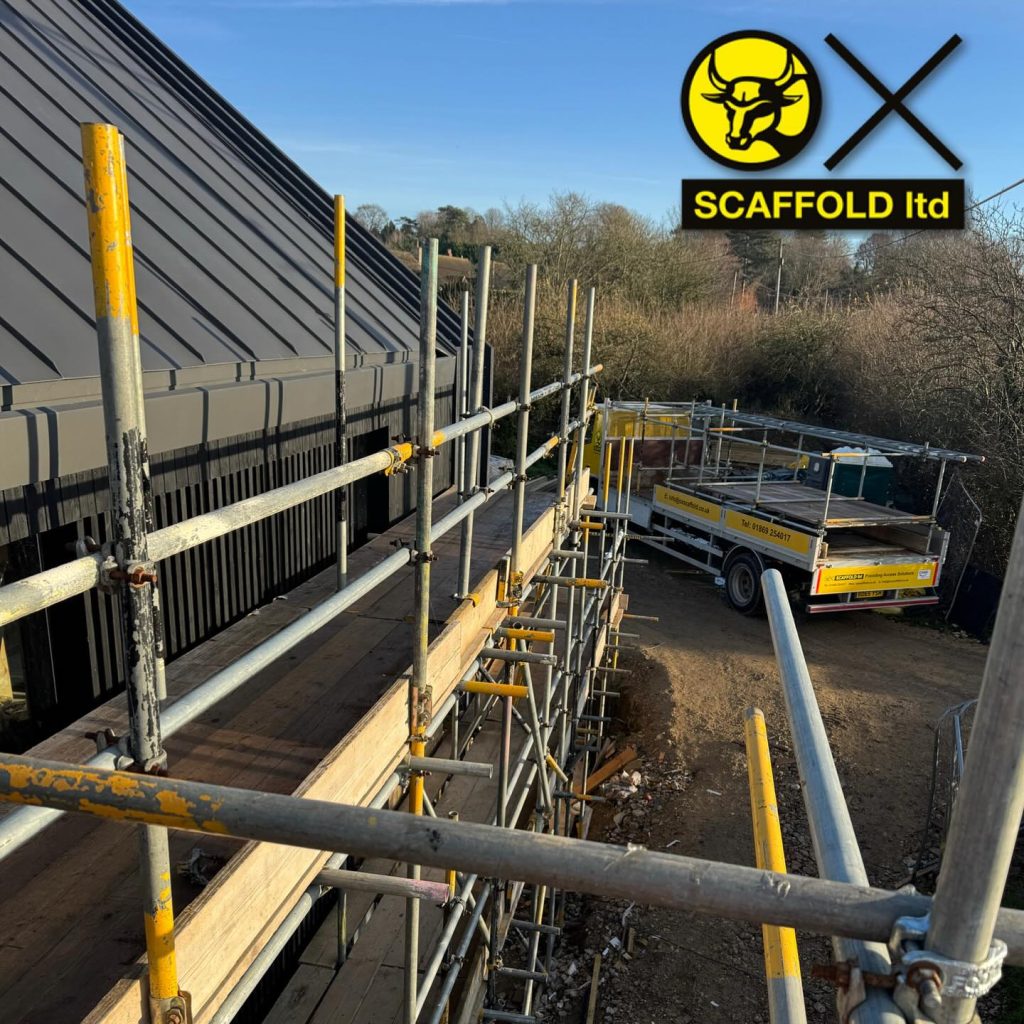
Timber-frame build, Long Crendon
A timber-frame new build in Long Crendon, where the job started where every good scaffold starts: at the base. Sole boards and base plates on properly prepared ground, so the scaffold stayed true as the frame went up around it.
Bernwood Park, Boarstall
Safe, stable access to the guttering, fascia and roof areas at Bernwood Park on the Bucks–Oxfordshire border, so the trades could work along the roofline of the hotel.
Aylesbury: a Garden Town around a medieval core
Aylesbury was designated a Garden Town in 2017, and the growth that came with it shapes most of the scaffolding work here. To the north-west, Berryfields has been building out since 2010 towards more than 3,000 homes; to the north-east, Kingsbrook is adding thousands more; to the south-east, Hampden Fields was approved in 2021 for around 3,000 homes. Before them came Fairford Leys, Watermead, Weedon Hill and Buckingham Park. Around those sit the post-war and older estates — Bedgrove, Southcourt, Quarrendon, Elmhurst — and at the centre, the Old Town.
Four kinds of town, four kinds of scaffold, and we price each for what it is.
The Old Town
Aylesbury’s Old Town is one of the earliest conservation areas in the country, designated in 1969, with well over a hundred listed buildings packed into a small hilltop around St Mary’s church. The King’s Head off the Market Square, a fifteenth-century coaching inn now owned by the National Trust, is listed Grade II*. The streets around it — Church Street, Temple Square, Parson’s Fee, Kingsbury — are narrow, sometimes cobbled, and lined with timber-framed, brick and rendered houses that sit hard against the footway.
- Ties are agreed, not assumed. Old brick, render over timber frame and listed fronts mean ties go into sound joints and through openings, with the fixings agreed where the building is listed.
- Access is tight. Narrow lanes decide the size of the lorry and the time of day it can stop.
- The pavement is the job. Frontages on the footway need the council’s licence and usually a protection fan.
Berryfields, Kingsbrook and the new estates
On the new estates the house is the easy part: modern cavity walls, predictable tying, repeated house types. What needs planning is the estate. Shared parking courts, narrow access roads and management company rules decide where a scaffold can stand and when we can deliver — and many estate roads are private or not yet adopted, in which case the permission comes from the estate company rather than the council. Typical work is extensions, loft conversions, re-roofs, rendering and solar. Newer ground can still be settling, so the base gets the attention it deserves.
Bedgrove, Southcourt and the post-war town
The bulk of Aylesbury’s houses are post-war semis and terraces, and the bulk of the work is extensions, loft conversions, re-roofs, new windows, solar and chimney repairs — the kind of job our 2023 chimney scaffold in the town was. Straightforward scaffolds, priced quickly, with the usual questions about side access and through-house carries on the terraces.
The Vale villages: thatch, witchert and timber frame
The villages around Aylesbury have building materials you do not see in Oxfordshire. Thatch is common — our scaffold for the thatch replacement in Dinton is typical: full-length platforms at the right height, clear of the old walls. Witchert, the chalky earth walling of Haddenham, Long Crendon and the villages around them, will not reliably take a scaffold anchor, so scaffolds against it are tied through openings or stand on their own. And there is a great deal of timber frame, old and new. On all of them the scaffold is built to protect the building as well as the people working on it.
Commercial Aylesbury
Commercial work in Aylesbury runs from the town centre — Friars Square, Hale Leys, the Waterside Theatre and the shops around the Market Square — to the industrial estates off Rabans Lane and the Gatehouse area, and to Stoke Mandeville Hospital. Trading hours, the public, inductions and permits set the programme; see commercial scaffolding and industrial scaffolding.
What Aylesbury and the Vale are built from
The quickest way to price an Aylesbury scaffold accurately is to know what the walls are made of, because that decides how the scaffold is tied to the building — and the Vale has more variety than almost anywhere we work.
- Brick and block cavity walls — Bedgrove, Southcourt, Fairford Leys and most of the new estates. Predictable, and they take drilled anchor ties well.
- Old brick, render and timber frame — the Old Town. Ties go into sound joints and through openings, and the frame or render is protected where the scaffold touches it.
- Witchert — the chalky earth walling of Haddenham, Long Crendon and the villages around them, usually on a stone base and under a tiled or thatched coping. It is soft, it does not hold an anchor, and it is damaged by water and knocks; scaffolds against it are tied through openings or stand on their own, and they are built to keep rain off the wall top.
- Thatch — Dinton, Haddenham, Long Crendon, Weston Turville and many more. The thatcher needs a full-length platform at the right height, and nothing may be fixed into the thatch.
- Modern timber frame — a growing share of new houses, like our Long Crendon build. The scaffold often stands on its own until the frame can take ties.
Using an Oxfordshire scaffolder in Aylesbury
We are based at Enslow, near Kidlington, so it is fair to ask why an Aylesbury customer would use us. The honest answer is that forty minutes along the A41 is a normal run for us, not a special trip: we price the travel into the job rather than adding it on, we plan deliveries so the scaffold arrives when it is needed, and mid-hire alterations are usually next-day. On anything that runs for weeks — an extension, a loft conversion, a re-roof, a thatch — the distance makes no difference to you. On a two-hour job, a firm round the corner may be the better answer, and we will tell you so.
How an Aylesbury job runs, from enquiry to strike
- Tell us the address and the work. Photographs are often enough on the estates; for the Old Town, a thatch, witchert or a commercial site we come and look.
- Written quotation. It states the scaffold, the duty class, the hire period, what is included and the weekly extension rate if the job runs on.
- Permissions. If the scaffold stands on a public footway or verge we apply to Buckinghamshire Council and allow around two weeks; on a private estate road we check whose permission is needed.
- Erection. Half a day to a day for a typical house, by CISRS-qualified scaffolders working to SG4.
- Handover. We inspect the finished scaffold, tag it, and hand over with the load class and any restrictions.
- Inspections and alterations. We inspect at intervals not exceeding seven days and after bad weather, and alter the scaffold when the job needs it.
- Strike. When the work is done we take it down and clear the site. Erection, strike and inspections are all in the price.
Approvals: one council for everything
Buckinghamshire has been a single unitary council since 2020, which makes Aylesbury simpler than two-tier Oxfordshire: the highway licence and the planning, conservation and listed building side all come from the same body.
- Buckinghamshire Council is the highway authority. A scaffold on a public footway, verge or road needs its licence under section 169 of the Highways Act 1980. The council’s published fee is £383.60 for a 28-day period (October 2026). Allow around two weeks, and longer where listed building consent is involved.
- The Aylesbury Town conservation area covers the Old Town; fixings into a listed front, and the work itself, often need consent.
- Private and unadopted estate roads — on Berryfields, Kingsbrook, Buckingham Park and the other new estates, check whose road it is; the management company’s permission may be the one that matters.
- Milton Keynes is separate. Bletchley and Newport Pagnell go to Milton Keynes City Council, not Buckinghamshire.
Licence figures are taken from the council’s published schedule. Fees change, so treat them as a budget figure until the application goes in.
What we put up in Aylesbury
- Domestic — extensions, loft conversions, re-roofs, rendering, windows and gutters across the estates.
- Chimney scaffolds — on the post-war estates and the older houses in town.
- Solar panel scaffolding — eaves edge protection to HSE guidance.
- Thatch and heritage — full-length platforms for thatchers, scaffolds that protect old walls.
- Commercial — the town centre, hotels, schools and offices, with the building in use.
- Temporary roofs — weather protection over a re-roof or a thatch.
- Scaffold inspections — our own scaffolds at every statutory interval, and reports on scaffolds put up by others.
The standards we work to
- TG20:21 — NASC technical guidance for tube-and-fitting scaffolds. Inside its scope the scaffold comes with a TG20 compliance sheet; a scaffold against witchert or thatch with no ties, a fan over an Old Town footway or a temporary roof takes you outside it and into a bespoke scaffold design.
- SG4 — NASC guidance on preventing falls while the scaffold is erected, altered or struck.
- BS EN 12811-1 — the duty classes. A class 2 painting scaffold and a class 4 masonry scaffold look the same from the street and are not the same thing.
- Work at Height Regulations 2005 — inspection before first use, at intervals not exceeding seven days, and after anything likely to affect the scaffold. We do those scaffold inspections as part of the hire.
- CDM 2015 — applies to domestic projects too, with the client duties passing to the contractor.
CISRS-qualified and CITB-trained scaffolders, Advanced CHAS accredited, £10 million public liability, RAMS and a job-specific toolbox talk before anyone starts.
How we price an Aylesbury job
There is no honest per-metre rate. On an Aylesbury job the number moves on:
- Duration — the biggest factor. Tell us the real programme and we price that.
- How much scaffold and how high — a Berryfields semi and an Old Town townhouse are different scaffolds.
- Duty class — what the work loads the platform with.
- How it is tied — joints and openings on old brick, no ties at all on witchert or thatch.
- Highway licence and protection — an Old Town frontage adds the licence and a fan.
- Access — a parking court on the estates, a narrow lane in the Old Town or a village.
- Repetition — identical estate houses priced as a run.
At forty minutes from the yard we plan Aylesbury deliveries properly, and we are close enough that mid-hire changes are usually next-day. The quotation states the duty class, the hire period, what is included and what is not.
Questions we get asked in Aylesbury
Scaffolders in Aylesbury, and what hiring us involves
Aylesbury is about forty minutes from our yard at Enslow, near Kidlington, along the A41 through Bicester. Scaffolding hire in Aylesbury is a hire period with erection, the statutory inspections and the strike included, and an honest extension cost if the job runs on.
- Free site visit and written quotation. Photographs are often enough on the estates; in the Old Town and the villages we come and look.
- Hire in weeks — four to eight typically.
- Adjustments mid-hire — ask us; never move it yourself.
- CISRS-qualified scaffolders, £10 million public liability, scafftags and recorded inspections.
Where in and around Aylesbury we work
- The Old Town and town centre. Market Square, Kingsbury, Church Street, Temple Square and Parson’s Fee.
- Berryfields, Kingsbrook and Hampden Fields. The Garden Town estates.
- Fairford Leys, Watermead, Weedon Hill and Buckingham Park. The earlier new estates.
- Bedgrove, Southcourt, Quarrendon and Elmhurst. Post-war and established housing.
- The Vale villages. Bierton, Stoke Mandeville, Weston Turville, Aston Clinton, Stone, Dinton, Haddenham, Long Crendon, Waddesdon and Whitchurch.
Who issues the scaffold licence in Aylesbury?
Buckinghamshire Council, the unitary authority, for any scaffold standing on a public footway, verge or road. Its published fee is £383.60 for a 28-day period (October 2026), and we allow around two weeks. Because the council is unitary, the planning, conservation and listed building side comes from the same body. We apply as the scaffolding contractor.
Do you cover the new estates like Berryfields and Kingsbrook?
Yes. The house is usually the easy part — modern cavity walls and predictable tying. What needs planning is the estate: shared parking courts, narrow access, management company rules and whether the road is adopted. Tell us which estate and we plan for it.
Can you scaffold a listed building in the Aylesbury Old Town?
Yes. The Old Town has been a conservation area since 1969 and has well over a hundred listed buildings. Ties go into sound joints and through openings, fixings are agreed where the building is listed, and a front scaffold on the footway needs the council’s licence and usually a protection fan.
Can you scaffold thatched and witchert buildings?
Yes. We scaffolded a thatch replacement in Dinton, and thatch work needs full-length platforms at the right height that do not bear on the old walls. Witchert, the earth walling of Haddenham and Long Crendon, will not take anchors, so scaffolds against it are tied through openings or designed to stand on their own.
How far are you from Aylesbury?
About forty minutes from our yard at Enslow, near Kidlington, along the A41. Far enough that we plan deliveries properly, close enough that mid-hire changes are usually next-day. Site visits and written quotations are free.
Do you do chimney scaffolding in Aylesbury?
Yes — our 2023 chimney repair scaffold in the town is typical: a scaffold up the elevation, a platform round the stack and edge protection at the eaves. Where the stack sits over a conservatory or lower roof, beams span it.
Do you do commercial scaffolding in Aylesbury?
Yes — the town centre, hotels, schools and the industrial estates off Rabans Lane and the Gatehouse area, worked around trading hours and site rules. We provided roofline access at Bernwood Park hotel in Boarstall.
How long does scaffolding hire in Aylesbury usually last?
Most domestic jobs run four to eight weeks — a re-roof two to four, an extension or loft conversion six to ten, a thatch or repointing job longer. The hire period is written into the quotation, and on a licensed footway scaffold we plan the strike to the 28-day licence.
Around Aylesbury
We cover the villages of the Vale, from Bierton and Stoke Mandeville to Haddenham, Long Crendon and Waddesdon. Nearby we have pages for Wendover, Princes Risborough, Thame, Bicester, Buckingham, Leighton Buzzard, High Wycombe and the county page for Buckinghamshire.
Got a job in Aylesbury?
Tell us the address and what the scaffold is for, and we will come and look. Site visits and written quotations are free.