Home » Our Work

The feed above is our actual Instagram, updated from site as jobs go up. It is not a stock gallery and it is not a selection of our best five jobs from 2019 — it is what we have been doing this month.
Scaffolding photographs tend to look alike to anyone outside the trade, so it is worth saying what is actually different between them. Most of what you will see falls into a handful of categories.
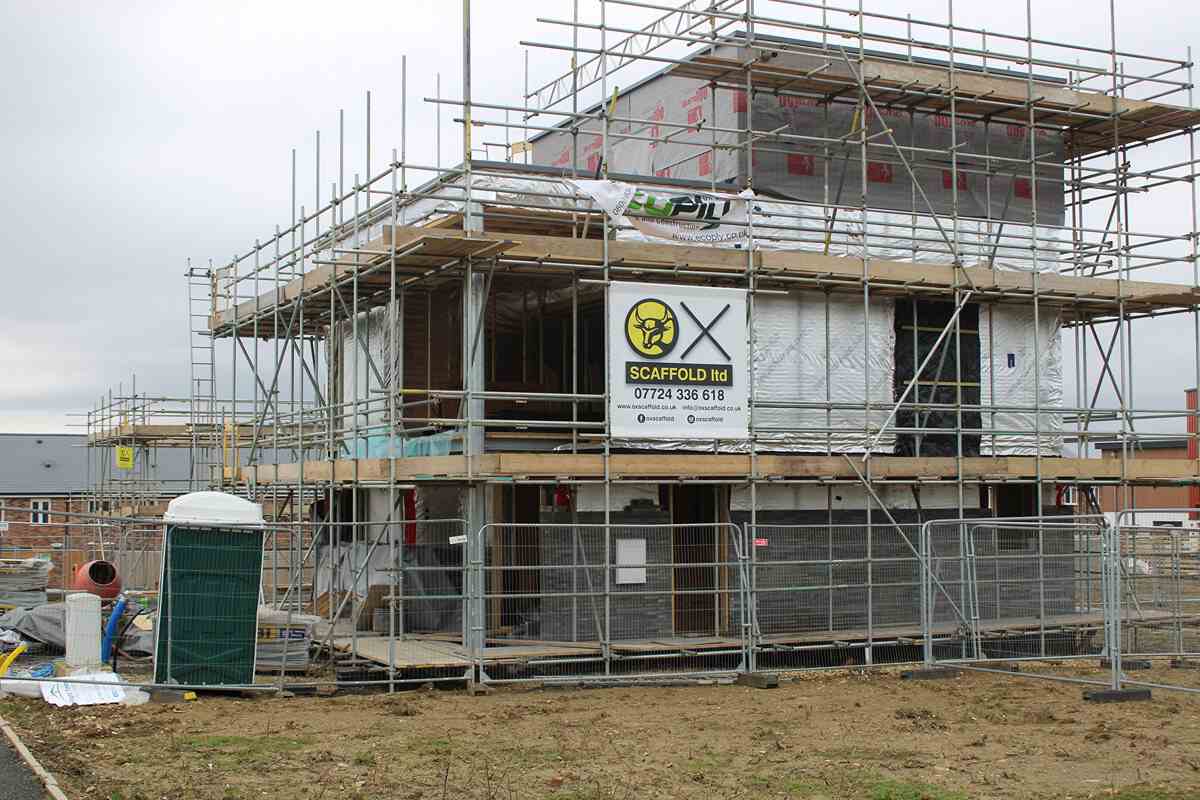
The bulk of our work. Two and three storey houses, usually a straightforward independent tied scaffold with a loading bay, often with a chute for the old tiles. The thing that varies is the ground: soft lawns, sloping drives and awkward side returns are what make one of these harder than another, not the height.
The ones with a sheeted roof over the whole building. These span up to 40 metres and are either craned in or run on a rolling track so the roofers can slide it back. They are the difference between a winter re-roof and a spring one.
Scaffolds with a fan, a footway guardrail and sometimes a pedestrian tunnel underneath. These need a licence from the highway authority under section 169 of the Highways Act 1980, and the licence usually sets the start date rather than our diary.
Stone, lime mortar and leadwork, where the scaffold cannot be tied the way it would be into modern blockwork. These need more thought at the design stage and more care on the way up.
In summer 2026 we designed and built the four-lane, 100-metre Slip n Slide structure at Millets Farm near Abingdon: a raised launch platform, stair tower and netted frame carrying the public for six weeks. Read the Slip n Slide at Millets Farm case study, or see our event scaffolding page.
Shops, offices, schools, churches and process buildings. The defining constraint is that the building usually stays open and working underneath, so the protection matters as much as the access.
Including plots at Graven Hill in Bicester. These run for months rather than weeks and get altered repeatedly as the build moves, which is why being fifteen minutes away matters.
Almost everything in the feed is within about forty minutes of our yard at Enslow Wharf, near Kidlington. In practice that means Oxford, Bicester, Kidlington, Banbury, Witney, Abingdon, Didcot and Thame across Oxfordshire; Aylesbury, Buckingham, Milton Keynes, High Wycombe and the South Bucks towns; Leighton Buzzard and Dunstable in Bedfordshire; and Brackley and Northampton to the north.
Ox Scaffold Ltd has been trading since June 2018 and has won Oxfordshire’s Scaffold Company of the Year at the Oxfordshire Prestige Awards every year since 2020. We are Advanced CHAS accredited, and our Google rating is 5.0 from 49 reviews.
Site visits and written quotations are free.
01869 254017 Follow @oxscaffold
We provide access solutions tailored to your requirements and have experience delivering on projects of considerable scale. Incorporated in 2018, Ox Scaffold Ltd have shown credibility within the industry and this was recognized by the Oxfordshire Prestige Awards from 2020 to present, winning ‘Oxfordshire’s Scaffold Company of the Year’.
Copyright © OX Scaffold Ltd | All Rights Reserved.